

The other day I went to my local coffee shop for the awkwardest of adult experiences – the first-friend date.
Nicole is classic genX: grungy, direct, deeply skeptical. Humble. Her story? Mindblowing.
Former Shell refinery executive in Singapore, one of the most sophisticated operations jobs on earth, moves home to California, settles in Truckee and opens a cookie shop.
I mean, honestly, it sounds straight out of a Hallmark movie. But with an edge.
This has always been my FAVORITE way to spend time: getting to know people’s stories. It’s what drew me to a career in journalism. It’s what led me to user-research and product.
The thread for me has always been the same: people are endlessly fascinating and how they choose to show up in this world will never, ever cease to amaze me.
It’s also my favorite part of my latest life and career iteration.
I launched Main Street Operator this year. Becoming an entrepreneur was always something I wanted, I just never knew exactly what. If you’d told 20-year-old me it would happen in mid-life, while raising two toddlers, I wouldn’t have believed you. But it never felt right until now. Survey data suggests most women who own businesses today launched them in their 40s. Holler.
I’m building this slowly, iterating my way forward. And honestly? That’s the most exciting (and terrifying) part. Every step compounds. Nobody tells you that early enough. Most of my career was spent tending to someone else’s ideas. This one’s mine.
This is the first in a series I’m hoping to do around things I believe. Hold me to it.
Here are 8 things I believe after 20 years working at the intersection of people, stories, and technology.
1. Local operators will save us.
Entrepreneurs serving local communities are some of the hardest working, biggest-hearted humans alive. In a world fracturing along every line, they’re the ones still building real connection: between neighbors, between businesses, between people who need something and people who provide it. Their work is vital.
2. Main Street remembers what corporations don’t: the point is to serve.
Corporations have drifted so far toward extraction that they’ve lost the plot. Main Street operators never did. They still measure success by whether the customer got what they needed, whether the crew got home safe, whether the work was done right. That orientation wins long-term. And in an AI arms race, it becomes an even bigger edge, Main Street never lost the human part. That’s why I do this work.
3. Local operators are incredibly sophisticated — just not in the ways we’ve been taught to value.
They’re masters of their craft, their customers, and their communities. The systems layer is the one piece they haven’t needed to own. That’s changing.
4. The thinking that builds billion-dollar tech products works just as well on Main Street
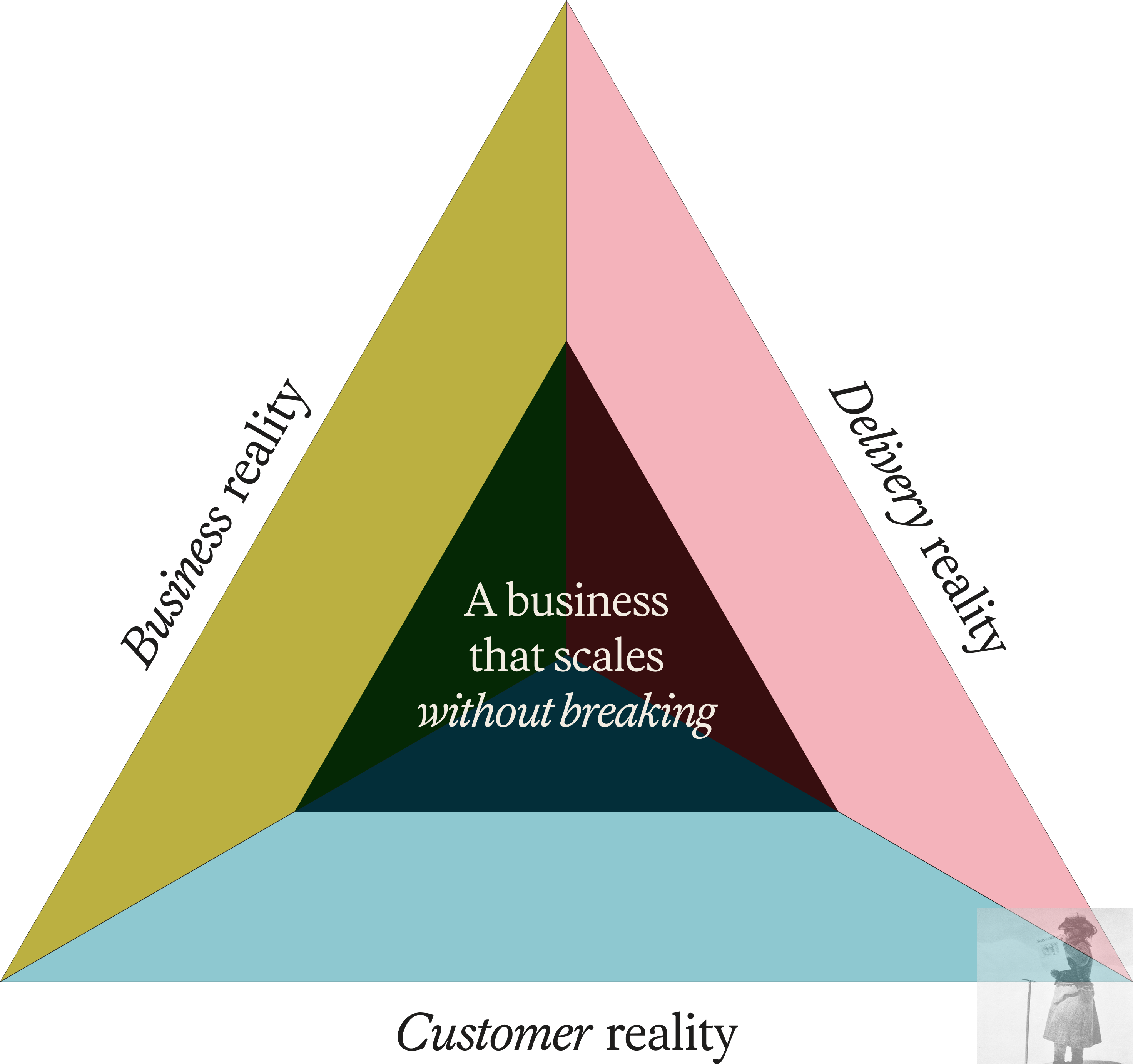
I spent years building products at Uber and Instacart. The core of that work was always three questions: Do people actually want this? Can we actually deliver it? Does the math actually work? Those same three questions — Customer Reality, Delivery Reality, Business Reality — unlock a wine shop, a paving company, a climbing gym. The Operator Triangle is product thinking applied to the businesses the world actually needs.
5. The power asymmetry between enterprise and Main Street is collapsing.
Enterprise software was always just a wrapper around a database: a $50K/year visibility layer to answer “what’s the status?” LLMs have blown that open. For the first time, a small operator can access their own data, build their own workflows, and run with the same intelligence that used to require a six-figure tech stack.
Sidenote for the nerds like me: The new dependency is on the model layer, which means workflows are portable…but hell if I know what that will mean long-term. Very curious to learn.
6. Operator intuition is an asset — but it creates a trap.
The operator’s gut has gotten them far. It works. Hell, most local service businesses make more than venture-backed Series B startups. But gut-driven decision-making requires the owner to be present for every call, every judgment, every fire. That’s the owner-operator bottleneck. The fix is to prove what the intuition already knows, so the business can act on it without the owner in the room. Run the business like an experiment. Get your time back.
7. Operational excellence beats financial engineering.
Private equity rolls up Main Street businesses by applying systems and squeezing margin. But an operator who builds tight systems, retains customers, and runs real margin doesn’t need to sell out to survive. They can outperform the PE-backed competitor down the street because they actually give a shit about the work, the people, and the community. You can beat PE at their own game without gutting the soul.
8. Both/and, not either/or.
Growth AND life. Ambition AND presence. The hustle-and-sacrifice narrative is a lie that benefits the people selling the hustle. You can build something meaningful without it consuming everything else. Watch me.
Got a belief of your own that drives your work? Lemme know!
3 Things That Caught My Attention This Week
📚 I’ve told everyone about this book — it’s written as a series of letters. The protagonist is highly imperfect. And there’s an EXCELLENT letter to Joan Didion that changed how I think about the concept of “seasons of life.”
🎧 New favorite podcast — Shoutout to @guestworkinvesting - I first came across Kaustubh through his excellent substack. Former PE guy, turns Main Street operator. I’ve listened to two episodes so far and love it. Two dudes shoot the shit about building real local service businesses. It’s the perfect mix of smart, bro-ey, and real.
📰 This was an excellently written, hella depressing, thought-provoking take — on the state of things in San Francisco and tech.
I'm obsessed with The Correspondent. I now have a penpal through booktok!
Love this concept and so pleased to find your work. ✨
Congrats on the launch on MainStreet Operator! Would love to check it out on my next trip to Tahoe